

Year Listed: 2012
County: Boulder, Gilpin, Grand County
Construction Date: 1903, rails moved 1930s
Threat When Listed: Demolition by Neglect – Vacant
Status: IN PROGRESS
The Moffat Road is an incredible story of engineering and entrepreneurship, of fortunes made and lost, of a Colorado pioneer who left a big mark on Colorado and transportation history. The Moffat Road was the brainchild of David Moffat and roughly follows an earlier constructed Wagon Road (Rollinsville and Middle Park Wagon Road, opened in 1873) that itself had been constructed on what was known as the “old Ute Trail.” Moffat started construction in Denver in April, 1903 on a railroad line that was intended to connect Denver first to NW Colorado through the Continental Divide, to Utah, and finally the West Coast. Engineers demanded that a tunnel be bored for the line, but finances were tight and so Moffat built a temporary line over the Continental Divide with the expectation that the line would hugely profitable and a tunnel could be constructed within a few years. However, operating costs were extraordinarily high and the tunnel wasn’t finished until the late 1920s, by which time Moffat had died.
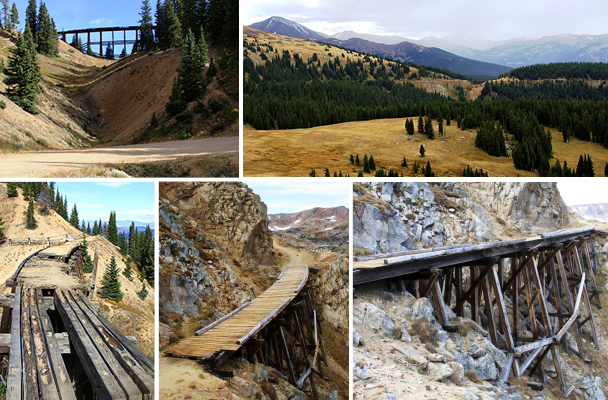
The Moffat Road is now located on public lands (USFS) within the Arapaho and Roosevelt National Forest. The rails were removed in the 1930s, but the railbed, several trestles, the Needle’s Eye Tunnel, telegraph poles, remnants of the snow sheds and foundations from the hotel and depot that were built atop the Divide at Rollins Pass remain. However, the extreme winter weather conditions that made the line so expensive to maintain are taking a serious toll on the remaining structures. The trestles in particular receive no maintenance and are exhibiting signs of deterioration and rot.
The Moffat Road is a hugely significant linear historic resource that speaks to the history of Colorado and the development of the American West. However, the story is being lost. The terminus stations of the Moffat Line are both vacant and in jeopardy. The Moffat Road over the Continental Divide is difficult to access, no longer a thru route, and interpretive materials seriously lacking. USFS cutbacks have resulted in very little maintenance for the remaining historic fabric and they are at risk of being lost.
Recently the Rollins Pass Restoration Association has been working to reopen the Moffat Road. A private land swap with USFS was stopped by CPI, Grand County, SHPO, and the Grand Old Broads of the Wilderness in 2021. Future goals include funding repairs to the Needle’s Eye Tunnel, restore east/west access, install signage, and to restore the Twin Trestles. Some are interested in applying for Rollins Pass and the Needles Eye Tunnel to become a National Monument!